




Retrieval-Augmented Generation (RAG) continues to be the backbone of most real-world AI applications that need accurate, contextual, and trustworthy responses.
While prompt engineering can nudge models and fine-tuning can shape them, RAG is still the most recommended and safest architectural approach when it comes to reducing hallucinations in LLM and AI applications — especially in enterprise, security, legal, and compliance-heavy environments.
At its core, RAG shifts AI from guessing to grounded reasoning.
Instead of relying only on what a model was trained on months (or years) ago, RAG enables AI systems to:
- Retrieve relevant, up-to-date information
- Ground responses in trusted data
- Generate answers based on evidence, not assumptions
Why RAG is preferred over “just prompts” or “just fine-tuning”
- Prompt engineering Useful, but brittle. Prompts can break, drift, or be bypassed — especially in complex or agentic systems.
- Fine-tuning Powerful, but expensive, slow to update, and risky for sensitive data. It also doesn’t scale well for fast-changing knowledge.
- RAG Flexible, scalable, safer, and production-friendly. You can update data instantly without retraining models, and you significantly reduce hallucination risk.
This is exactly why RAG has become the default pattern for modern AI applications — from internal knowledge assistants to security copilots and agentic AI systems.
A quick bit of history (because context matters)
RAG was formally introduced in a landmark 2020 research paper by Patrick Lewis and colleagues at Facebook AI (Meta).
That work addressed a fundamental limitation of static language models:
they generate fluent answers, but don’t actually “know” when they are wrong.
By combining external knowledge retrieval with language generation, the paper showed how models could deliver more accurate, factual, and up-to-date responses. The term Retrieval-Augmented Generation itself was coined in that research, although the underlying ideas had been evolving for years in information retrieval and QA systems.
Why understanding RAG is non-negotiable today
If you’re learning modern AI fundamentals, understanding RAG is not optional anymore. Whether you’re:
- Building AI products
- Designing agentic workflows
- Working on AI security or governance
- Teaching or mentoring others in AI
RAG is one of the first concepts you should get comfortable with.
Excellent YouTube videos to learn RAG (2025)
If you want a solid, end-to-end understanding of RAG from concepts to hands-on implementation, these videos are worth your time:
OpenAI – RAG overview https://platform.openai.com/docs/guides/retrieval
Pinecone – What is RAG (excellent visuals) https://www.pinecone.io/learn/retrieval-augmented-generation/
LangChain RAG docs https://docs.langchain.com/docs/use-cases/question-answering/
Llama Index RAG concepts https://docs.llamaindex.ai/en/stable/getting_started/concepts/
OWASP LLM Top 10 (hallucinations, data exposure) https://owasp.org/www-project-top-10-for-large-language-model-applications/
Introduction to Understanding RAG (Retrieval-Augmented Generation) 🎥 Krish Naik 🔗 https://youtu.be/fZM3oX4xEyg
Introduction to Retrieval Augmented Generation (RAG) 🎥 Google Cloud 🔗 https://youtu.be/snnEemhULew
Retrieval-Augmented Generation (RAG), Clearly Explained — Why It Matters 🎥 Builders Central 🔗 https://youtu.be/VioF7v8Mikg
A Helping Hand for LLMs — Retrieval Augmented Generation 🎥 Computerphile 🔗 https://youtu.be/of4UDMvi2Kw
Learn RAG From Scratch 🎥 freeCodeCamp 🔗 https://youtu.be/sVcwVQRHIc8
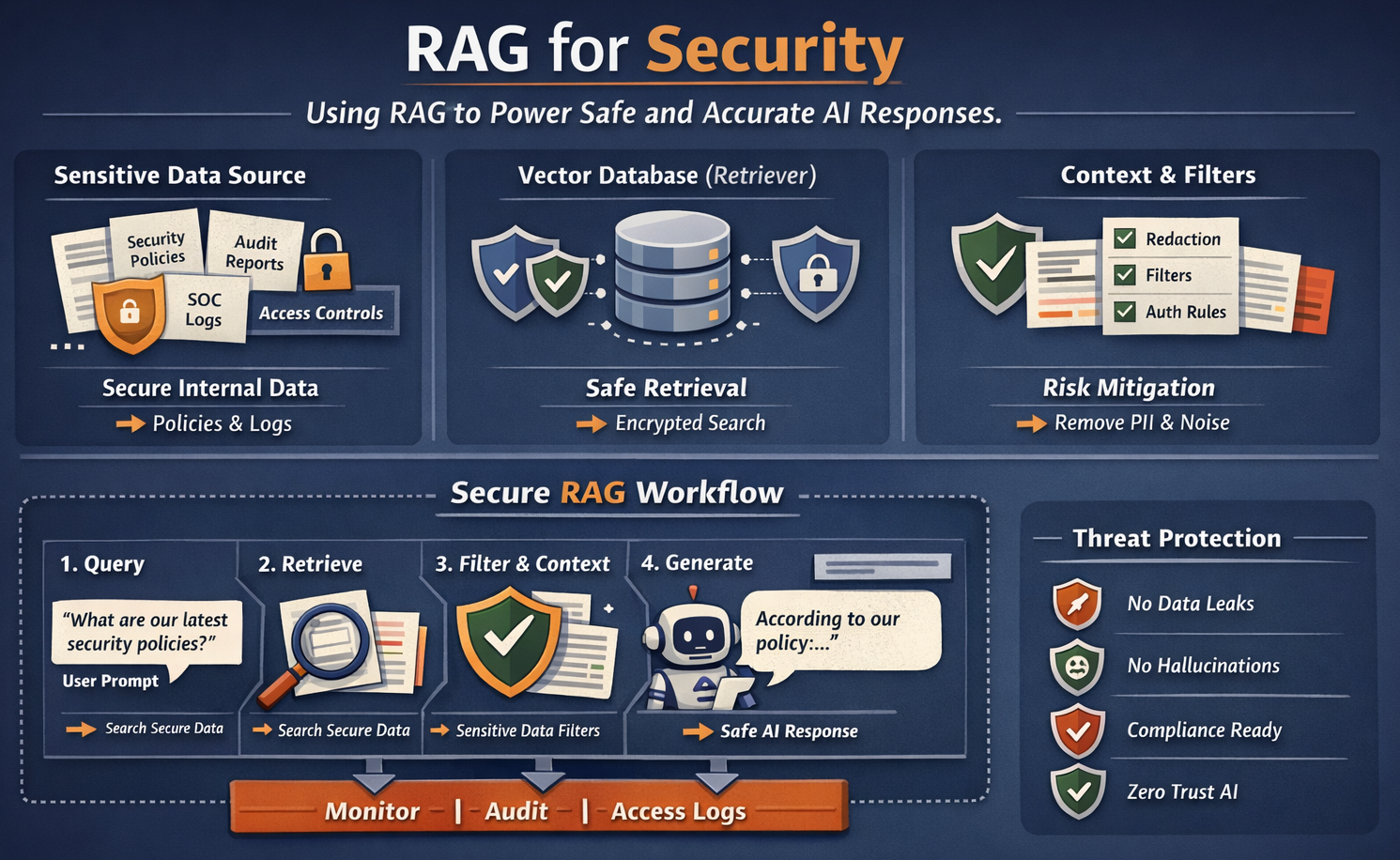
AI Generated Image of RAG
More RAG videos worth watching (recommended additions)
If you want to go deeper, especially into architecture, scaling, and real-world use cases, I’d also recommend:
- RAG at Scale – Architecture & Design Patterns (by Pinecone / Weaviate talks)
- LangChain + RAG Deep Dive (official LangChain YouTube sessions)
- LlamaIndex RAG Internals Explained
- RAG vs Fine-Tuning – When to Use What (practitioner talks)
- RAG Failure Modes & Evaluation (hallucinations, retrieval drift, context stuffing)
These are especially useful if you’re building production-grade or agentic AI systems.
One last thing
I also run a YouTube channel where I regularly share hands-on AI concepts, practical demos, and learning resources across AI, LLMs, and security-aware AI design:
🎥 My YouTube Channel 🔗 https://www.youtube.com/@Infosecvandana